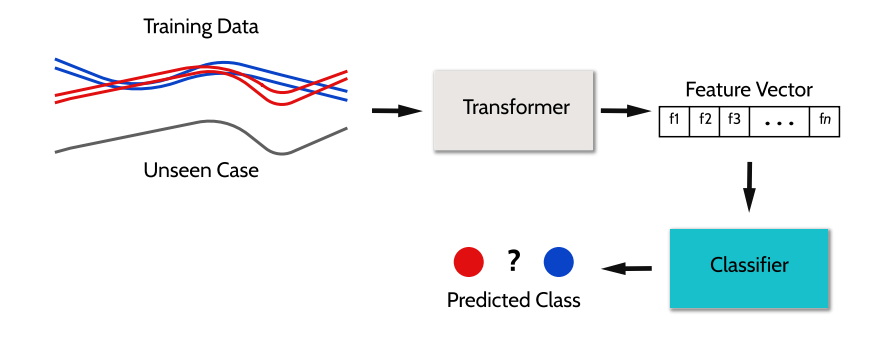
TDMVDCClassifier
- class TDMVDCClassifier(default_fc_parameters='efficient', k1=2, k2=2, feature_store_ratios=None, n_jobs=1, parallel_backend=None)[source]
Bases:
BaseClassifierTracking Differentiator-based Multiview Dilated Characteristics classifier.
The TDMVDCClassifier is an advanced ensemble classifier tailored for time series classification tasks. It operates by transforming the input time series data through a tracking differentiator, generating three distinct views: the original signal, the first-order differential, and the second-order differential. Each of these views is further processed using a set of dilation rates, allowing the model to capture temporal dependencies and patterns at multiple scales.
For each dilated view, the classifier extracts a comprehensive set of features using the TSFresh feature extraction framework. These features are then evaluated using ANOVA F-values to determine their relevance to the classification task. Multiple classifiers are constructed, each trained on a different proportion of the most informative features, as determined by the feature selection process. The ensemble of classifiers provides robust predictions by aggregating their outputs through a hard voting mechanism, which enhances generalization and reduces the risk of overfitting.
The TDMVDCClassifier is highly parallelized, supporting multi-threaded feature extraction and model training to efficiently handle large datasets. Its design is particularly effective for time series problems where both the original and differential characteristics of the data, as well as multiscale temporal patterns, are important for accurate classification.
- Parameters:
- default_fc_parametersstr, default=”efficient”
Specifies the set of TSFresh features to extract. Options include “minimal”, “efficient”, or “comprehensive”.
- k1float, default=2
Filter parameter for the first tracking differentiator, controlling the generation of first-order differential series.
- k2float, default=2
Filter parameter for the second tracking differentiator, controlling the generation of second-order differential series.
- feature_store_ratioslist, default=None
List of feature retention ratios for different feature selectors. If None, defaults to [0.1, 0.2, 0.3, 0.4, 0.5].
- n_jobsint, default=1
Number of parallel jobs to run for feature extraction and model training. “-1” uses all available processors.
- parallel_backendstr, ParallelBackendBase instance or None, default=None
Specifies the parallelization backend for joblib. Options include “loky”, “multiprocessing”, “threading”, or a custom backend.
- Attributes:
- n_classes_int
Number of unique classes in the training data.
- classes_ndarray of shape (n_classes_)
Array of class labels.
- clfList_list
List of trained classifier pipelines for each feature subset.
- dList_ndarray
Array of dilation rates used for multiscale feature extraction.
- tsFreshListR_list
List of TSFresh feature extractors for original signal at each dilation rate.
- tsFreshListF_list
List of TSFresh feature extractors for the first-order differential signal at each dilation rate.
- tsFreshListS_list
List of TSFresh feature extractors for the second-order differential signal at each dilation rate.
- scoreRFS_ndarray
Array of ANOVA F-values for all extracted features, used for feature selection.
Notes
Capabilities ¶ Missing Values
No
Multithreading
Yes
Univariate
Yes
Multivariate
No
Unequal Length
No
Train Estimate
No
Contractable
No
The TDMVDCClassifier is particularly effective for time series datasets where capturing both the original and differential dynamics, as well as multiscale temporal features, is crucial for distinguishing between classes. Its ensemble approach and feature selection strategy help to mitigate overfitting and improve predictive performance on complex datasets.
For the algorithm details, see [1].
References
[1]Changchun He, and Xin Huo. “Tracking Differentiator-based Multiview Dilated Characteristics for Time Series Classification.” in The 22nd IEEE International Conference on Industrial Informatics (INDIN2024) (2024).
Methods
clone([random_state])Obtain a clone of the object with the same hyperparameters.
fit(X, y)Fit time series classifier to training data.
fit_predict(X, y, **kwargs)Fits the classifier and predicts class labels for X.
fit_predict_proba(X, y, **kwargs)Fits the classifier and predicts class label probabilities for X.
get_class_tag(tag_name[, raise_error, ...])Get tag value from estimator class (only class tags).
Get class tags from estimator class and all its parent classes.
get_fitted_params([deep])Get fitted parameters.
get_params([deep])Get parameters for this estimator.
get_tag(tag_name[, raise_error, ...])Get tag value from estimator class.
get_tags()Get tags from estimator.
predict(X)Predicts class labels for time series in X.
Predicts class label probabilities for time series in X.
reset([keep])Reset the object to a clean post-init state.
score(X, y[, metric, use_proba, metric_params])Scores predicted labels against ground truth labels on X.
set_params(**params)Set the parameters of this estimator.
set_score_request(*[, metric, ...])Configure whether metadata should be requested to be passed to the
scoremethod.set_tags(**tag_dict)Set dynamic tags to given values.
- clone(random_state=None)[source]
Obtain a clone of the object with the same hyperparameters.
A clone is a different object without shared references, in post-init state. This function is equivalent to returning
sklearn.cloneofself. Equal in value totype(self)(**self.get_params(deep=False)).- Parameters:
- random_stateint, RandomState instance, or None, default=None
Sets the random state of the clone. If
None, the random state is not set. Ifint,random_stateis the seed used by the random number generator. IfRandomStateinstance,random_stateis the random number generator.
- Returns:
- estimatorobject
Instance of
type(self), clone of self (see above)
- fit(X, y) BaseCollectionEstimator[source]
Fit time series classifier to training data.
- Parameters:
- Xnp.ndarray or list
Input data, any number of channels, equal length series of shape
(
n_cases, n_channels, n_timepoints)
or 2D np.array (univariate, equal length series) of shape(n_cases, n_timepoints)or list of numpy arrays (any number of channels, unequal length series) of shape[n_cases], 2D np.array(n_channels, n_timepoints_i), wheren_timepoints_iis length of seriesi. Other types are allowed and converted into one of the above.Different estimators have different capabilities to handle different types of input. If
self.get_tag("capability:multivariate")is False, they cannot handle multivariate series, so eithern_channels == 1is true or X is 2D of shape(n_cases, n_timepoints). Ifself.get_tag( "capability:unequal_length")is False, they cannot handle unequal length input. In both situations, aValueErroris raised if X has a characteristic that the estimator does not have the capability for is passed.- ynp.ndarray
1D np.array of float or str, of shape
(n_cases)- class labels (ground truth) for fitting indices corresponding to instance indices in X.
- Returns:
- selfBaseClassifier
Reference to self.
- Raises:
- ValueError
If
Xhas multivariate series but the estimator does not havecapability:multivariatetag set to True.- ValueError
If
Xhas unequal length series but the estimator does not havecapability:unequal_lengthtag set to True.- TypeError
If
yis apd.DataFramewith more than one column.
Notes
Changes state by creating a fitted model that updates attributes ending in “_” and sets is_fitted flag to True.
- fit_predict(X, y, **kwargs) ndarray[source]
Fits the classifier and predicts class labels for X.
fit_predict produces prediction estimates using just the train data. By default, this is through 10x cross validation, although some estimators may utilise specialist techniques such as out-of-bag estimates or leave-one-out cross-validation.
Classifiers which override _fit_predict will have the
capability:train_estimatetag set to True.Generally, this will not be the same as fitting on the whole train data then making train predictions. To do this, you should call fit(X,y).predict(X)
- Parameters:
- Xnp.ndarray or list
Input data, any number of channels, equal length series of shape
(
n_cases, n_channels, n_timepoints)
or 2D np.array (univariate, equal length series) of shape(n_cases, n_timepoints)or list of numpy arrays (any number of channels, unequal length series) of shape[n_cases], 2D np.array(n_channels, n_timepoints_i), wheren_timepoints_iis length of seriesi. other types are allowed and converted into one of the above.Different estimators have different capabilities to handle different types of input. If
self.get_tag("capability:multivariate")is False, they cannot handle multivariate series, so eithern_channels == 1is true or X is 2D of shape(n_cases, n_timepoints). Ifself.get_tag( "capability:unequal_length")is False, they cannot handle unequal length input. In both situations, aValueErroris raised if X has a characteristic that the estimator does not have the capability for is passed.- ynp.ndarray
1D np.array of float or str, of shape
(n_cases)- class labels (ground truth) for fitting indices corresponding to instance indices in X.- kwargsdict
key word arguments to configure the default cross validation if the base class default fit_predict is used (i.e. if function
_fit_predictis not overridden. If_fit_predictis overridden, kwargs may not function as expected. If_fit_predictis not overridden, valid input iscv_sizeinteger, which is the number of cross validation folds to use to estimate train data. Ifcv_sizeis not passed, the default is 10. Ifcv_sizeis greater than the minimum number of samples in any class, it is set to this minimum.
- Returns:
- predictionsnp.ndarray
shape
[n_cases]- predicted class labels indices correspond to instance indices in
- Raises:
- ValueError
If
Xhas multivariate series but the estimator does not havecapability:multivariatetag set to True.- ValueError
If
Xhas unequal length series but the estimator does not havecapability:unequal_lengthtag set to True.- ValueError
If
cv_sizeis not an integer greater than 0.- ValueError
If all classes have fewer than 2 samples, making cross-validation impossible.
- fit_predict_proba(X, y, **kwargs) ndarray[source]
Fits the classifier and predicts class label probabilities for X.
fit_predict_proba produces probability estimates using just the train data. By default, this is through 10x cross validation, although some estimators may utilise specialist techniques such as out-of-bag estimates or leave-one-out cross-validation.
Classifiers which override _fit_predict_proba will have the
capability:train_estimatetag set to True.Generally, this will not be the same as fitting on the whole train data then making train predictions. To do this, you should call fit(X,y).predict_proba(X)
- Parameters:
- Xnp.ndarray or list
Input data, any number of channels, equal length series of shape
(
n_cases, n_channels, n_timepoints)
or 2D np.array (univariate, equal length series) of shape(n_cases, n_timepoints)or list of numpy arrays (any number of channels, unequal length series) of shape[n_cases], 2D np.array(n_channels, n_timepoints_i), wheren_timepoints_iis length of seriesi. other types are allowed and converted into one of the above.Different estimators have different capabilities to handle different types of input. If
self.get_tag("capability:multivariate")is False, they cannot handle multivariate series, so eithern_channels == 1is true or X is 2D of shape(n_cases, n_timepoints). Ifself.get_tag( "capability:unequal_length")is False, they cannot handle unequal length input. In both situations, aValueErroris raised if X has a characteristic that the estimator does not have the capability for is passed.- ynp.ndarray
1D np.array of float or str, of shape
(n_cases)- class labels (ground truth) for fitting indices corresponding to instance indices in X.- kwargsdict
key word arguments to configure the default cross validation if the base class default fit_predict is used (i.e. if function
_fit_predictis not overridden. If_fit_predictis overridden, kwargs may not function as expected. If_fit_predictis not overridden, valid input iscv_sizeinteger, which is the number of cross validation folds to use to estimate train data. Ifcv_sizeis not passed, the default is 10. Ifcv_sizeis greater than the minimum number of samples in any class, it is set to this minimum.
- Returns:
- probabilitiesnp.ndarray
2D array of shape
(n_cases, n_classes)- predicted class probabilities First dimension indices correspond to instance indices in X, second dimension indices correspond to class labels, (i, j)-th entry is estimated probability that i-th instance is of class j
- Raises:
- ValueError
If
Xhas multivariate series but the estimator does not havecapability:multivariatetag set to True.- ValueError
If
Xhas unequal length series but the estimator does not havecapability:unequal_lengthtag set to True.- ValueError
If
cv_sizeis not an integer greater than 0.- ValueError
If all classes have fewer than 2 samples, making cross-validation impossible.
- classmethod get_class_tag(tag_name, raise_error=True, tag_value_default=None)[source]
Get tag value from estimator class (only class tags).
- Parameters:
- tag_namestr
Name of tag value.
- raise_errorbool, default=True
Whether a
ValueErroris raised when the tag is not found.- tag_value_defaultany type, default=None
Default/fallback value if tag is not found and error is not raised.
- Returns:
- tag_value
Value of the
tag_nametag in cls. If not found, returns an error ifraise_errorisTrue, otherwise it returnstag_value_default.
- Raises:
- ValueError
if
raise_errorisTrueandtag_nameis not inself.get_tags().keys()
Examples
>>> from aeon.classification import DummyClassifier
>>> DummyClassifier.get_class_tag("capability:multivariate")
True
- classmethod get_class_tags()[source]
Get class tags from estimator class and all its parent classes.
- Returns:
- collected_tagsdict
Dictionary of tag name and tag value pairs. Collected from
_tagsclass attribute via nested inheritance. These are not overridden by dynamic tags set byset_tagsor class__init__calls.
- get_fitted_params(deep=True)[source]
Get fitted parameters.
- State required:
Requires state to be “fitted”.
- Parameters:
- deepbool, default=True
If
True, will return the fitted parameters for this estimator and contained subobjects that are estimators.
- Returns:
- fitted_paramsdict
Fitted parameter names mapped to their values.
- get_params(deep=True)
Get parameters for this estimator.
- Parameters:
- deepbool, default=True
If True, will return the parameters for this estimator and contained subobjects that are estimators.
- Returns:
- paramsdict
Parameter names mapped to their values.
- get_tag(tag_name, raise_error=True, tag_value_default=None)[source]
Get tag value from estimator class.
Includes dynamic and overridden tags.
- Parameters:
- tag_namestr
Name of tag to be retrieved.
- raise_errorbool, default=True
Whether a
ValueErroris raised when the tag is not found.- tag_value_defaultany type, default=None
Default/fallback value if tag is not found and error is not raised.
- Returns:
- tag_value
Value of the
tag_nametag in self. If not found, returns an error ifraise_errorisTrue, otherwise it returnstag_value_default.
- Raises:
- ValueError
if raise_error is
Trueandtag_nameis not inself.get_tags().keys()
Examples
>>> from aeon.classification import DummyClassifier
>>> d = DummyClassifier()
>>> d.get_tag("capability:multivariate")
True
- get_tags()[source]
Get tags from estimator.
Includes dynamic and overridden tags.
- Returns:
- collected_tagsdict
Dictionary of tag name and tag value pairs. Collected from
_tagsclass attribute via nested inheritance and then any overridden and new tags from__init__orset_tags.
- predict(X) ndarray[source]
Predicts class labels for time series in X.
- Parameters:
- Xnp.ndarray or list
Input data, any number of channels, equal length series of shape
(
n_cases, n_channels, n_timepoints)
or 2D np.array (univariate, equal length series) of shape(n_cases, n_timepoints)or list of numpy arrays (any number of channels, unequal length series) of shape[n_cases], 2D np.array(n_channels, n_timepoints_i), wheren_timepoints_iis length of seriesiother types are allowed and converted into one of the above.Different estimators have different capabilities to handle different types of input. If
self.get_tag("capability:multivariate")is False, they cannot handle multivariate series, so eithern_channels == 1is true or X is 2D of shape(n_cases, n_timepoints). Ifself.get_tag( "capability:unequal_length")is False, they cannot handle unequal length input. In both situations, aValueErroris raised if X has a characteristic that the estimator does not have the capability for is passed.
- Returns:
- predictionsnp.ndarray
1D np.array of float, of shape (n_cases) - predicted class labels indices correspond to instance indices in X
- Raises:
- ValueError
If
Xhas multivariate series but the estimator does not havecapability:multivariatetag set to True.- ValueError
If
Xhas unequal length series but the estimator does not havecapability:unequal_lengthtag set to True.- ValueError
If the time series length of
Xdoes not match the length seen during fit.- ValueError
If the number of channels in
Xdoes not match the number of channels seen during fit (for multivariate estimators).- NotFittedError
If the classifier has not been fitted yet (
fitnot called).
- predict_proba(X) ndarray[source]
Predicts class label probabilities for time series in X.
- Parameters:
- Xnp.ndarray or list
Input data, any number of channels, equal length series of shape
(
n_cases, n_channels, n_timepoints)
or 2D np.array (univariate, equal length series) of shape(n_cases, n_timepoints)or list of numpy arrays (any number of channels, unequal length series) of shape[n_cases], 2D np.array(n_channels, n_timepoints_i), wheren_timepoints_iis length of seriesi. other types are allowed and converted into one of the above.Different estimators have different capabilities to handle different types of input. If
self.get_tag("capability:multivariate")is False, they cannot handle multivariate series, so eithern_channels == 1is true or X is 2D of shape(n_cases, n_timepoints). Ifself.get_tag( "capability:unequal_length")is False, they cannot handle unequal length input. In both situations, aValueErroris raised if X has a characteristic that the estimator does not have the capability for is passed.
- Returns:
- probabilitiesnp.ndarray
2D array of shape
(n_cases, n_classes)- predicted class probabilities First dimension indices correspond to instance indices in X, second dimension indices correspond to class labels, (i, j)-th entry is estimated probability that i-th instance is of class j
- Raises:
- ValueError
If
Xhas multivariate series but the estimator does not havecapability:multivariatetag set to True.- ValueError
If
Xhas unequal length series but the estimator does not havecapability:unequal_lengthtag set to True.- ValueError
If the time series length of
Xdoes not match the length seen during fit.- ValueError
If the number of channels in
Xdoes not match the number of channels seen during fit (for multivariate estimators).- NotFittedError
If the classifier has not been fitted yet (
fitnot called).
- reset(keep=None)[source]
Reset the object to a clean post-init state.
After a
self.reset()call,selfis equal or similar in value totype(self)(**self.get_params(deep=False)), assuming no other attributes were kept usingkeep.- Detailed behaviour:
- removes any object attributes, except:
hyper-parameters (arguments of
__init__) object attributes containing double-underscores, i.e., the string “__”
runs
__init__with current values of hyperparameters (result ofget_params)- Not affected by the reset are:
object attributes containing double-underscores class and object methods, class attributes any attributes specified in the
keepargument
- Parameters:
- keepNone, str, or list of str, default=None
If
None, all attributes are removed except hyperparameters. Ifstr, only the attribute with this name is kept. Iflistofstr, only the attributes with these names are kept.
- Returns:
- selfobject
Reference to self.
- Raises:
- TypeError
If ‘keep’ is not a string or a list of strings.
- score(X, y, metric='accuracy', use_proba=False, metric_params=None) float[source]
Scores predicted labels against ground truth labels on X.
- Parameters:
- Xnp.ndarray or list
Input data, any number of channels, equal length series of shape
(
n_cases, n_channels, n_timepoints)
or 2D np.array (univariate, equal length series) of shape(n_cases, n_timepoints)or list of numpy arrays (any number of channels, unequal length series) of shape[n_cases], 2D np.array(n_channels, n_timepoints_i), wheren_timepoints_iis length of seriesi. other types are allowed and converted into one of the above.Different estimators have different capabilities to handle different types of input. If
self.get_tag("capability:multivariate")is False, they cannot handle multivariate series, so eithern_channels == 1is true or X is 2D of shape(n_cases, n_timepoints). Ifself.get_tag( "capability:unequal_length")is False, they cannot handle unequal length input. In both situations, aValueErroris raised if X has a characteristic that the estimator does not have the capability for is passed.- ynp.ndarray
1D np.array of float or str, of shape
(n_cases)- class labels (ground truth) for fitting indices corresponding to instance indices in X.- metricUnion[str, callable], default=”accuracy”,
Defines the scoring metric to test the fit of the model. For supported strings arguments, check sklearn.metrics.get_scorer_names.
- use_probabool, default=False,
Argument to check if scorer works on probability estimates or not.
- metric_paramsdict, default=None,
Contains parameters to be passed to the scoring function. If None, no parameters are passed.
- Returns:
- scorefloat
Accuracy score of predict(X) vs y.
- Raises:
- ValueError
If
metricis a string not found insklearn.metrics.get_scorer_names().- ValueError
If
metricis not a string or callable.- NotFittedError
If the classifier has not been fitted yet (
fitnot called).
- set_params(**params)
Set the parameters of this estimator.
The method works on simple estimators as well as on nested objects (such as
Pipeline). The latter have parameters of the form<component>__<parameter>so that it’s possible to update each component of a nested object.- Parameters:
- **paramsdict
Estimator parameters.
- Returns:
- selfestimator instance
Estimator instance.
- set_score_request(*, metric: bool | None | str = '$UNCHANGED$', metric_params: bool | None | str = '$UNCHANGED$', use_proba: bool | None | str = '$UNCHANGED$') TDMVDCClassifier
Configure whether metadata should be requested to be passed to the
scoremethod.Note that this method is only relevant when this estimator is used as a sub-estimator within a meta-estimator and metadata routing is enabled with
enable_metadata_routing=True(seesklearn.set_config). Please check the User Guide on how the routing mechanism works.The options for each parameter are:
True: metadata is requested, and passed toscoreif provided. The request is ignored if metadata is not provided.False: metadata is not requested and the meta-estimator will not pass it toscore.None: metadata is not requested, and the meta-estimator will raise an error if the user provides it.str: metadata should be passed to the meta-estimator with this given alias instead of the original name.
The default (
sklearn.utils.metadata_routing.UNCHANGED) retains the existing request. This allows you to change the request for some parameters and not others.Added in version 1.3.
- Parameters:
- metricstr, True, False, or None, default=sklearn.utils.metadata_routing.UNCHANGED
Metadata routing for
metricparameter inscore.- metric_paramsstr, True, False, or None, default=sklearn.utils.metadata_routing.UNCHANGED
Metadata routing for
metric_paramsparameter inscore.- use_probastr, True, False, or None, default=sklearn.utils.metadata_routing.UNCHANGED
Metadata routing for
use_probaparameter inscore.
- Returns:
- selfobject
The updated object.