TimeSeriesKMedoids
- class TimeSeriesKMedoids(n_clusters: int = 8, init: str | ndarray = 'random', distance: str | Callable = 'msm', method: str = 'pam', n_init: int = 10, max_iter: int = 300, tol: float = 1e-06, verbose: bool = False, random_state: int | RandomState | None = None, distance_params: dict | None = None)[source]
Bases:
BaseClustererTime series K-medoids implementation.
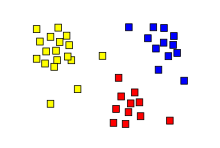
K-medoids [1] is a clustering algorithm that aims to partition n observations into k clusters in which each observation belongs to the cluster with the nearest medoid/centroid. This results in a partitioning of the data space into Voronoi cells. The problem of finding k-medoids is known to be NP-hard and has a time complexity of :
\[\mathbf{O}(\mathbf{n}\mathbf{k}(\mathbf{n} - \mathbf{k})^2).\]Where n is the number of time series and k is the number of clusters. There have been a number of algorithms published to solve the problem. The most common is the PAM (Partition Around Medoids)[R9ed115bfe2e7-3]_ algorithm and is the default method used in this implementation. However, an adaptation of Lloyd’s method classically used for k-means is also available by specifying method=’alternate’. Alternate is faster but less accurate than PAM. For a full review of variations of k-medoids for time series see [5].
K-medoids for time series uses a dissimilarity method to compute the distance between time series. The default is ‘msm’ (move split merge) as it was found to significantly outperform the other measures in [2].
- Parameters:
- n_clustersint, default=8
The number of clusters to form as well as the number of centroids to generate.
- initstr or np.ndarray, default=’random’
Method for initialising cluster centers. Any of the following are valid: [‘kmedoids++’, ‘random’, ‘first’, ‘build’]. Random is the default as it is very fast and it was found in [2] to perform about as well as the other methods. Kmedoids++ is a variant of kmeans++ [4] and is slower but often more accurate than random. It works by choosing centroids that are distant from one another. First is the fastest method and simply chooses the first k time series as centroids. Build [1] greedily selects the k medoids by first selecting the medoid that minimizes the sum of distances to all other points (this point is the most centrally located) and then iteratively selects the next k-1 medoids that maximizes the decrease in sum of distances of all other points to their respective medoids selected so far. If an np.ndarray is provided it must be of shape (n_clusters,) and contain the indices of the time series to use as centroids.
- distancestr or Callable, default=’msm’
Distance method to compute similarity between time series. A list of valid strings for measures can be found in the documentation for
aeon.distances.get_distance_function. If a callable is passed it must be a function that takes two 2d numpy arrays as input and returns a float.- methodstr, default=’pam’
Method for computing k-medoids. Any of the following are valid: [‘alternate’, ‘pam’]. Alternate applies Lloyd’s method to k-medoids and is faster but less accurate than PAM. PAM is implemented using the fastpam1 algorithm which gives the same output as PAM but is faster.
- n_initint, default=10
Number of times the k-medoids algorithm will be run with different centroid seeds. The final result will be the best output of n_init consecutive runs in terms of inertia.
- max_iterint, default=300
Maximum number of iterations of the k-medoids algorithm for a single run.
- tolfloat, default=1e-6
Relative tolerance with regards to Frobenius norm of the difference in the cluster centers of two consecutive iterations to declare convergence.
- verbosebool, default=False
Verbosity mode.
- random_stateint, np.random.RandomState instance or None, default=None
Determines random number generation for centroid initialization. If int, random_state is the seed used by the random number generator; If np.random.RandomState instance, random_state is the random number generator; If None, the random number generator is the RandomState instance used by np.random.
- distance_params: dict, default=None
Dictionary containing kwargs for the distance method being used.
- Attributes:
- cluster_centers_np.ndarray, of shape (n_cases, n_channels, n_timepoints)
A collection of time series instances that represent the cluster centers.
- labels_np.ndarray (1d array of shape (n_cases,))
Labels indicating the cluster index assigned to each time series.
- inertia_float
Sum of squared distances of samples to their closest cluster center, weighted by the sample weights if provided.
- n_iter_int
Number of iterations run.
Notes
Capabilities ¶ Missing Values
No
Multithreading
No
Univariate
Yes
Multivariate
Yes
Unequal Length
No
References
[1]Kaufman, Leonard & Rousseeuw, Peter. (1987). Clustering by Means of Medoids.
Data Analysis based on the L1-Norm and Related Methods. 405-416.
[2]Holder, Christopher & Middlehurst, Matthew & Bagnall, Anthony. (2022).
A Review and Evaluation of Elastic Distance Functions for Time Series Clustering. 10.48550/arXiv.2205.15181.
[3]Kaufman, L. and Rousseeuw, P.J. (1990). Partitioning Around Medoids
(Program PAM). In Finding Groups in Data (eds L. Kaufman and P.J. Rousseeuw). https://doi.org/10.1002/9780470316801.ch2
[4]Arthur, David & Vassilvitskii, Sergei. (2007). K-Means++: The Advantages of
Careful Seeding. Proc. of the Annu. ACM-SIAM Symp. on Discrete Algorithms. 8. 1027-1035. 10.1145/1283383.1283494.
[5]Holder, Christopher & Guijo-Rubio, David & Bagnall, Anthony. (2023).
Clustering time series with k-medoids based algorithms. In proceedings of the 8th Workshop on Advanced Analytics and Learning on Temporal Data (AALTD 2023).
Examples
>>> from aeon.clustering import TimeSeriesKMedoids
>>> from aeon.datasets import load_basic_motions
>>> # Load data
>>> X_train, y_train = load_basic_motions(split="TRAIN")[0:10]
>>> X_test, y_test = load_basic_motions(split="TEST")[0:10]
>>> # Example of PAM clustering
>>> km = TimeSeriesKMedoids(n_clusters=3, distance="euclidean", random_state=1)
>>> km.fit(X_train)
TimeSeriesKMedoids(distance='euclidean', n_clusters=3, random_state=1)
>>> pam_pred = km.predict(X_test)    # Example of alternate clustering
>>> km = TimeSeriesKMedoids(n_clusters=3, distance="dtw", method="alternate",
...                         random_state=1)
>>> km.fit(X_train)
TimeSeriesKMedoids(distance='dtw', method='alternate', n_clusters=3,
                   random_state=1)
>>> alternate_pred = km.predict(X_test)
Methods
clone([random_state])Obtain a clone of the object with the same hyperparameters.
fit(X[, y])Fit time series clusterer to training data.
fit_predict(X[, y])Compute cluster centers and predict cluster index for each time series.
get_class_tag(tag_name[, raise_error, ...])Get tag value from estimator class (only class tags).
Get class tags from estimator class and all its parent classes.
get_fitted_params([deep])Get fitted parameters.
get_params([deep])Get parameters for this estimator.
get_tag(tag_name[, raise_error, ...])Get tag value from estimator class.
get_tags()Get tags from estimator.
predict(X)Predict the closest cluster each sample in X belongs to.
Predicts labels probabilities for sequences in X.
reset([keep])Reset the object to a clean post-init state.
set_params(**params)Set the parameters of this estimator.
set_tags(**tag_dict)Set dynamic tags to given values.
- clone(random_state=None)[source]
Obtain a clone of the object with the same hyperparameters.
A clone is a different object without shared references, in post-init state. This function is equivalent to returning
sklearn.cloneofself. Equal in value totype(self)(**self.get_params(deep=False)).- Parameters:
- random_stateint, RandomState instance, or None, default=None
Sets the random state of the clone. If
None, the random state is not set. Ifint,random_stateis the seed used by the random number generator. IfRandomStateinstance,random_stateis the random number generator.
- Returns:
- estimatorobject
Instance of
type(self), clone of self (see above)
- fit(X, y=None) BaseCollectionEstimator[source]
Fit time series clusterer to training data.
- Parameters:
- X3D np.ndarray (any number of channels, equal length series)
of shape (n_cases, n_channels, n_timepoints)
- or 2D np.array (univariate, equal length series)
of shape (n_cases, n_timepoints)
- or list of numpy arrays (any number of channels, unequal length series)
of shape [n_cases], 2D np.array (n_channels, n_timepoints_i), where n_timepoints_i is length of series i
other types are allowed and converted into one of the above.
- y: ignored, exists for API consistency reasons.
- Returns:
- self:
Fitted estimator.
- fit_predict(X, y=None) ndarray[source]
Compute cluster centers and predict cluster index for each time series.
Convenience method; equivalent of calling fit(X) followed by predict(X)
- Parameters:
- Xnp.ndarray (2d or 3d array of shape (n_cases, n_timepoints) or shape
(n_cases, n_channels, n_timepoints)). Time series instances used to train the clusterer and return their assigned cluster indices.
- y: ignored, exists for API consistency reasons.
- Returns:
- np.ndarray (1d array of shape (n_cases,))
Index of the cluster each time series in X belongs to.
- classmethod get_class_tag(tag_name, raise_error=True, tag_value_default=None)[source]
Get tag value from estimator class (only class tags).
- Parameters:
- tag_namestr
Name of tag value.
- raise_errorbool, default=True
Whether a
ValueErroris raised when the tag is not found.- tag_value_defaultany type, default=None
Default/fallback value if tag is not found and error is not raised.
- Returns:
- tag_value
Value of the
tag_nametag in cls. If not found, returns an error ifraise_errorisTrue, otherwise it returnstag_value_default.
- Raises:
- ValueError
if
raise_errorisTrueandtag_nameis not inself.get_tags().keys()
Examples
>>> from aeon.classification import DummyClassifier
>>> DummyClassifier.get_class_tag("capability:multivariate")
True
- classmethod get_class_tags()[source]
Get class tags from estimator class and all its parent classes.
- Returns:
- collected_tagsdict
Dictionary of tag name and tag value pairs. Collected from
_tagsclass attribute via nested inheritance. These are not overridden by dynamic tags set byset_tagsor class__init__calls.
- get_fitted_params(deep=True)[source]
Get fitted parameters.
- State required:
Requires state to be “fitted”.
- Parameters:
- deepbool, default=True
If
True, will return the fitted parameters for this estimator and contained subobjects that are estimators.
- Returns:
- fitted_paramsdict
Fitted parameter names mapped to their values.
- get_params(deep=True)
Get parameters for this estimator.
- Parameters:
- deepbool, default=True
If True, will return the parameters for this estimator and contained subobjects that are estimators.
- Returns:
- paramsdict
Parameter names mapped to their values.
- get_tag(tag_name, raise_error=True, tag_value_default=None)[source]
Get tag value from estimator class.
Includes dynamic and overridden tags.
- Parameters:
- tag_namestr
Name of tag to be retrieved.
- raise_errorbool, default=True
Whether a
ValueErroris raised when the tag is not found.- tag_value_defaultany type, default=None
Default/fallback value if tag is not found and error is not raised.
- Returns:
- tag_value
Value of the
tag_nametag in self. If not found, returns an error ifraise_errorisTrue, otherwise it returnstag_value_default.
- Raises:
- ValueError
if raise_error is
Trueandtag_nameis not inself.get_tags().keys()
Examples
>>> from aeon.classification import DummyClassifier
>>> d = DummyClassifier()
>>> d.get_tag("capability:multivariate")
True
- get_tags()[source]
Get tags from estimator.
Includes dynamic and overridden tags.
- Returns:
- collected_tagsdict
Dictionary of tag name and tag value pairs. Collected from
_tagsclass attribute via nested inheritance and then any overridden and new tags from__init__orset_tags.
- predict(X) ndarray[source]
Predict the closest cluster each sample in X belongs to.
- Parameters:
- X3D np.ndarray
Input data, any number of channels, equal length series of shape
(
n_cases, n_channels, n_timepoints)
or 2D np.array (univariate, equal length series) of shape(n_cases, n_timepoints)or list of numpy arrays (any number of channels, unequal length series) of shape[n_cases], 2D np.array(n_channels, n_timepoints_i), wheren_timepoints_iis length of seriesi. Other types are allowed and converted into one of the above.
- Returns:
- np.array
shape
(n_cases,), index of the cluster to which each time series in X belongs.
- predict_proba(X) ndarray[source]
Predicts labels probabilities for sequences in X.
Default behaviour is to call _predict and set the predicted class probability to 1, other class probabilities to 0. Override if better estimates are obtainable.
- Parameters:
- X3D np.ndarray
Input data, any number of channels, equal length series of shape
(
n_cases, n_channels, n_timepoints)
or 2D np.array (univariate, equal length series) of shape(n_cases, n_timepoints)or list of numpy arrays (any number of channels, unequal length series) of shape[n_cases], 2D np.array(n_channels, n_timepoints_i), wheren_timepoints_iis length of seriesi. Other types are allowed and converted into one of the above.
- Returns:
- y2D array of shape [n_cases, n_classes] - predicted class probabilities
1st dimension indices correspond to instance indices in X 2nd dimension indices correspond to possible labels (integers) (i, j)-th entry is predictive probability that i-th instance is of class j
- reset(keep=None)[source]
Reset the object to a clean post-init state.
After a
self.reset()call,selfis equal or similar in value totype(self)(**self.get_params(deep=False)), assuming no other attributes were kept usingkeep.- Detailed behaviour:
- removes any object attributes, except:
hyper-parameters (arguments of
__init__) object attributes containing double-underscores, i.e., the string “__”
runs
__init__with current values of hyperparameters (result ofget_params)- Not affected by the reset are:
object attributes containing double-underscores class and object methods, class attributes any attributes specified in the
keepargument
- Parameters:
- keepNone, str, or list of str, default=None
If
None, all attributes are removed except hyperparameters. Ifstr, only the attribute with this name is kept. Iflistofstr, only the attributes with these names are kept.
- Returns:
- selfobject
Reference to self.
- Raises:
- TypeError
If ‘keep’ is not a string or a list of strings.
- set_params(**params)
Set the parameters of this estimator.
The method works on simple estimators as well as on nested objects (such as
Pipeline). The latter have parameters of the form<component>__<parameter>so that it’s possible to update each component of a nested object.- Parameters:
- **paramsdict
Estimator parameters.
- Returns:
- selfestimator instance
Estimator instance.